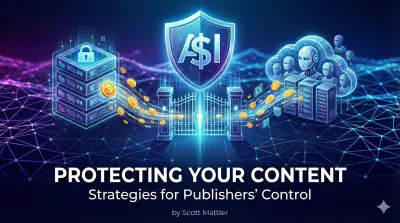
If there’s anything I’ve learned from my decade in digital marketing, all advertising dollars flow through digital publishers, but somehow publishers are still coming up short.
In a world where making every impression counts, publishers are continuously having to navigate one industry disruption after another just to keep the lights on. At times it can be taxing, confusing, all-out chaos – with the most recent disruptor being, you guessed it, AI.
If you’re a digital publisher watching AI platforms summarize your content without receiving revenue or traffic, you’re witnessing “Google Zero” – in other words, another form of highway robbery (traffic pun intended). But here’s what most publishers don’t realize: you have more control than you think against the Googles and AI behemoths if you know how to protect and monetize what you’ve built.
The Content Paradox
AI platforms need your content. That’s how they learn and thrive. ChatGPT, Claude (Claude guy here), and Google’s AI Overviews depend on authoritative sources – news publishers, recipe bloggers, specialized niche creators. Your reporting, analysis, and expertise power these AI responses.
The problem? General AI scrapers are taking your content for free. No compensation. No attribution. No traffic.
For news publishers: Your breaking stories get summarized before readers click. For content creators: Your specialized knowledge is making AI smarter (and wealthier), but at your own cost.
It doesn’t have to be all doom and gloom. Publishers can fight back, and the tools exist today.
Taking Control: Block, Gate, and Monetize
Step 1: Block the General Scrapers
Not all AI access is created equal. General scrapers that indiscriminately harvest content without compensation should be blocked. This isn’t about stopping all AI – it’s about controlling who uses your content and how.
Publishers can implement robots.txt rules and technical measures to prevent unauthorized AI scraping. Think of it as a water filter, separating the good from bad.
Step 2: Gate Your Content Strategically
The future of publisher-AI relationships isn’t an open door policy – it’s curated access through modern infrastructure. Model Context Protocol (MCP) servers allow publishers to gate content rather than give it up for free.
Here’s how it works: Place MCP servers at your site’s front door. When an AI platform requests your content, you control terms of what gets shared, and to whom. This creates a negotiation point instead of a free-for-all.
Think of MCP as your bouncer – it decides who gets in and what they can access based on your rules..and a cover fee.
Step 3: Define Your Assets with AdCP
The announcement of Advertising Context Protocol (AdCP) on October 15th, 2025 by Scope3 and other founding members has taken the ad industry by storm. The AdCP was created on the basis of how agents should talk to each other and communicate in the new era of agentic advertising and solve problems with existing media buying and selling.
While AdCP is slightly past the embryonic stage, it’s a disruption publishers can’t ignore. On top of MCP infrastructure, publishers need to define their content and audience as distinct, valuable objects. This is where AdCP becomes critical.
AdCP allows you to define:
- User objects: Who your audience is, their behaviors, their value
- Content objects: What makes your content authoritative, unique, valuable
When AI platforms or advertisers want access to your content or audience, they’re negotiating for defined, valuable assets – not just scraping whatever they can grab.
This flips the relationship dynamic from “AI takes what it wants” to “AI licenses what it needs from publishers who control the supply.”
What This Means for Your Business
For news publishers: Your breaking news headlines, investigative reporting, and local coverage become licensed assets, not free inputs. When AI uses your story, you get compensated accordingly.
For content creators: Your specialized expertise – whether recipes, health information, or financial insights – gets properly valued and monetized when AI uses it.
For any publisher: Your first-party audience data becomes a negotiable asset. AI platforms license your content, and advertisers pay to reach your engaged audience – both on your terms.
The Three Questions to Ask Yourself
- Are you blocking unauthorized AI scrapers? If general scrapers are taking your content without permission or compensation, you’re leaving money on the table.
- Do you have infrastructure to gate your content? Can you control who accesses your content and under what terms, or is everything up for grabs?
- Can you explain what makes your content and audience valuable? When AI platforms or advertisers come knocking, can you tell them exactly what they’re paying for – who your readers are, why your content matters, and what makes both worth real money?
If you answered “no” to any of these, you’re giving away assets that should be generating revenue. These aren’t free samples at Panda Express.
The Path Forward
The rise of AI Agents and Open Protocols is fundamentally changing the digital landscape.
This shift creates a massive integration headache for publishers, who are already facing diminishing traffic from “Google Zero” and declining revenue. This pressure causes many to pause, hoping to research and understand the “right” next move while trying to coordinate multiple vendors just to achieve their goals.
Springwire.ai eliminates this complexity and the need to wait. We provide the single, trusted platform that integrates these new protocols, equipping publishers of all sizes to:
- Block unauthorized scrapers
- Gate content through modern protocols (MCP)
- Define and monetize your assets (AdCP)
- Negotiate with AI platforms from a position of power
- All while continuing to monetize in traditional ways.
The Google Zero era doesn’t have to be about publishers losing – it’s an opportunity for publishers to stand up to big tech and win.
Publishers and content creators have the content that AI desperately needs. The question is whether you’re leveraging it correctly.
The publishers who move now will own the supply side of the AI economy. Those who wait will keep giving it away for free.